Padel Terminology Guide
Padel is played in Spanish. Not the sport itself – the language of it. Watch any Premier Padel match and you will hear bandeja, víbora, chiquita, por tres, punto de oro, and unless someone tells you what they mean, you are watching a great match with the commentary switched off.
This is the fix. Every term you need to follow a match, call the score, argue a line call correctly, and name what you just did on court – with the official rule behind it where a rule exists. Rules are as per the International Padel Federation (FIP) Rules of Padel, in force from 1 January 2026.
How to use it: click any term in the index to jump straight to it. Bookmark the page and come back mid-match.
1. The court, part by part
Almost every argument in padel – was it out, was it good, can I go out there – is settled by knowing what the ball touched. So start here.
Pista (the court)
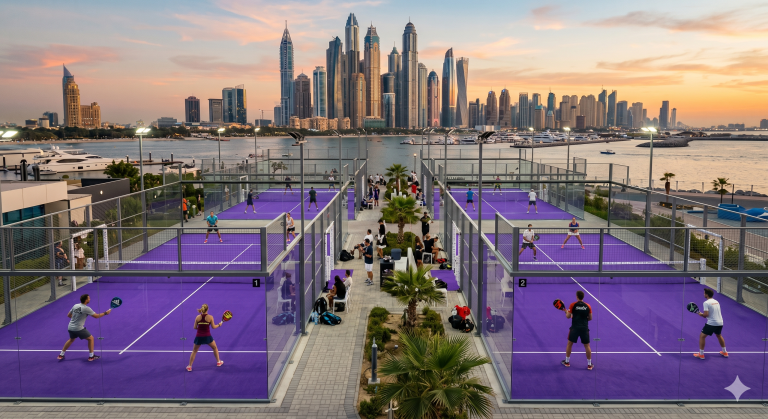
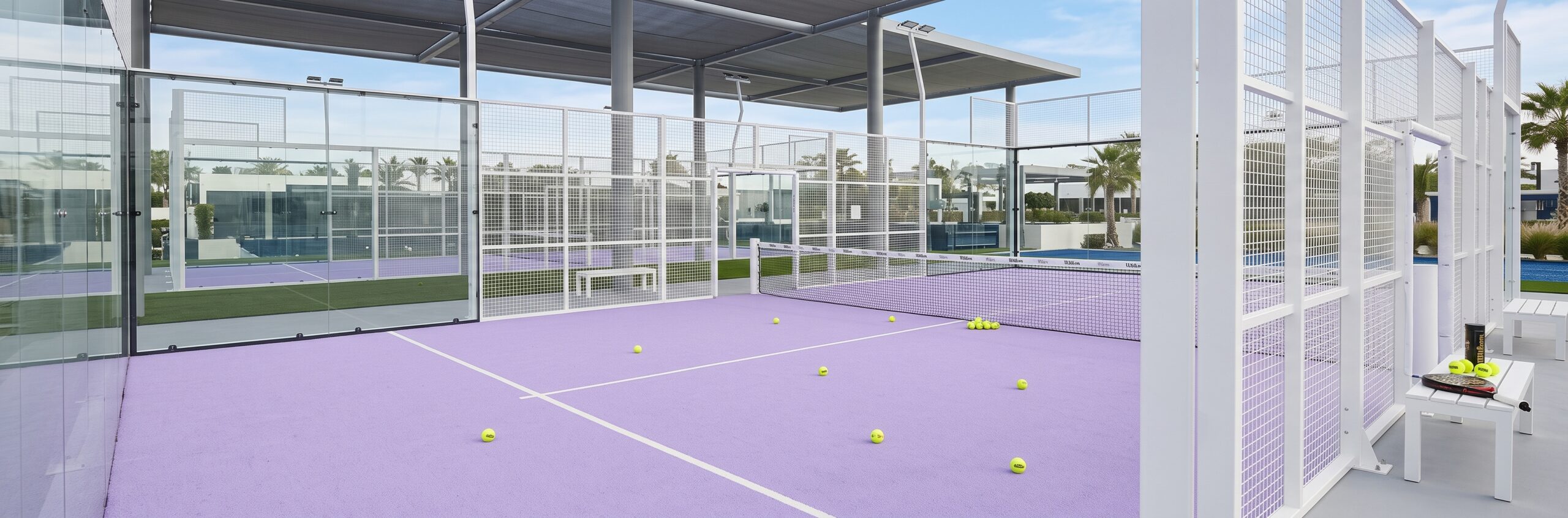
20 m long by 10 m wide inside the enclosure, divided in half by the net. Minimum free height above the court is 6 m (8 m recommended for new builds). Unlike tennis, the whole thing is a sealed box – the walls are part of the playing surface.
Red (the net)
10 m long, 0.88 m high in the centre and 0.92 m at the posts – it sags in the middle by design, which is exactly why the middle is the cheapest place to attack.
Cristal / pared (the glass wall)
The transparent wall. Pared literally means “wall”; cristal means “glass”. Commentators use both interchangeably. The ball comes off glass fast and predictably – it is your friend in defence.
Fondo (the back glass)
The back wall behind each pair. Per FIP, the first 3 m of the back is solid wall or glass, topped by 1 m of metal fence – total 4 m. Remember that 4: it is where the name por cuatro comes from.
Lateral (the side glass)
The side walls. They step down as they approach the net – glass at the back, lower glass further forward, with fence completing the enclosure to roughly 3 m along most of the side. Remember that 3: hence por tres.
Reja / verja / malla (the fence)
The metal part of the enclosure, above and beside the glass. The FIP rulebook calls it the metallic fence throughout, which is why “fence” is the term you’ll hear in English commentary; “mesh” and Spanish reja, verja or malla all mean the same thing. Critically, fence is not glass in the rules: the ball comes off it dead and unpredictably, a serve that bounces in the box then hits the fence is a fault, and you may never play your own return into your own fence. The holes are 5-7.08 cm diagonally with 2-3 mm wire.
Pico (the seam)
The join where glass meets fence. A ball that lands on the pico is a lottery – it can drop dead, shoot sideways, or die in the corner. When a commentator says “al pico“, they mean a shot deliberately aimed there.
Rincón (the corner)
Where the back glass meets the side glass. The hardest place in padel to defend from, because the ball can rebound off two surfaces in sequence.
Puerta (the door)
The access gate in each side wall. Not decoration: it is the escape hatch players sprint through to chase a ball that has left the court (see fuera de pista).
Cuadro de saque (service box)
The box the serve must land in, diagonally opposite the server. The service lines sit 6.95 m from the net on each side, and the centre line splits the two boxes.
Lado de drive / lado de revés (forehand side / backhand side)
Padel pairs do not swap sides mid-rally: one player owns the right-hand side (drive or derecha) and one owns the left (revés). For two right-handers, the revés player covers the middle with their forehand and is usually the more aggressive finisher – which is why commentators talk about a pair’s “left-side player” as a role, not a position.
Tierra de nadie (no man’s land)
The dead zone around the service line where you are too far back to volley and too far forward to use the glass. Padel is played at the net or at the back – being caught here is a tactical error, and commentators will say so.
Zona de seguridad (the outside area)
The clear space outside the enclosure. Out-of-court play is only legal if the venue provides two access doors per side and an obstacle-free area of at least 3 m wide, 4 m long and 3 m high. A lamp post in the way means no going out on that court.
2. Scoring and match format
Scoring is borrowed from tennis, with one padel-specific twist that decides more matches than anything else on this page: the golden point.
Punto, juego, set, partido (point, game, set, match)
Points run 15, 30, 40, game. Six games with a two-game lead wins a set. Two sets win a match (best of three). Peloteo is the rally itself.
Love / cero (zero)
Zero points. “Forty-love” is 40-0. In Spanish you will simply hear cero.
All / iguales (tied)
A tied score inside a game – “30 all” is 30-30.
Deuce / iguales a 40
40-40. In the traditional advantage scoring system, a pair must then win two points in a row to take the game.
Ventaja (advantage)
The point won immediately after deuce. Win the next one too and you take the game; lose it and the score returns to deuce.
Punto de oro (golden point)
The defining feature of modern padel. At 40-40 there is no advantage: one single point decides the game. The receiving pair chooses which side receives it – so watch which returner steps across, because that choice is a tactical statement. Used across the professional tours and most club leagues.
Punto estrella (star point)
A middle option in the FIP rules: the game goes through deuce 1, deuce 2 and deuce 3, and only then is a single deciding “star point” played, again with the receivers choosing the side. Rare, but it is in the rulebook.
Break / quiebre (break of serve)
The receiving pair winning the game. Because the serve in padel is underarm and weak, breaks are common – which is why “hold” is a genuine achievement and commentators make a fuss about it.
Bola de break / de set / de partido (break, set and match point)
A point that, if won, wins the game against serve, the set, or the match. At a golden point on the receivers’ racket, it is a break point by definition.
Tie-break
Played at 6-6 in games. First pair to 7 points with a two-point margin. The first server serves one point from the right, then each pair serves two consecutive points, and the pairs change ends every 6 points.
Super tie-break
A tie-break to 10 points instead of 7, used in place of a deciding third set in many club and amateur formats.
Cambio de lado (change of ends)
Pairs change ends after the 1st, 3rd and every subsequent odd game of a set, and every 6 points in a tie-break. If you forget, you correct it as soon as anyone notices – points already played still stand.
Peloteo de calentamiento (warm-up)
The cooperative knock-up before a match. Not competitive – feeding your opponent a playable ball here is basic etiquette.
3. The serve and the return
Saque (the serve)
Underarm, always. The rules require you to: stand behind the service line between the centre line and the side wall; bounce the ball on the ground first; strike it at or below waist height; keep at least one foot on the ground; and send it diagonally into the opposite service box. You get two attempts, as in tennis. The moment you make contact – or genuinely try to – it counts as a serve.
Bote (the bounce)
Generic word for the ball bouncing – on the floor, off the glass, anywhere. “Doble bote” is a double bounce; “el bote del saque” is the pre-serve bounce.
Falta de pie (foot fault)
Touching or crossing the service line, or the imaginary extension of the centre line, before contact. Also covers lifting both feet off the ground or standing outside your half.
Falta (fault)
An invalid serve. It is a fault if you break any of the positioning or contact rules, miss the ball entirely, land the serve outside the correct box, hit yourself or your partner – or if the serve bounces correctly in the box and then hits the metal fence before its second bounce. That last one is the rule club players get wrong most often.
Serve into the glass – and why it’s legal
A serve that lands in the box and then hits the side glass is perfectly good, and the returner has to deal with it. Same serve hitting the fence instead: fault. Glass yes, fence no – the entire art of the padel serve lives in that distinction.
Doble falta (double fault)
Both serves faulted: point to the receivers.
Let (net serve)
The serve clips the net or a post and still lands correctly in the box: replay that serve. But if it clips the net, lands in the box and then hits the fence before bouncing twice, it is a fault, not a let.
Resto (the return)
The return of serve, and the most important shot in padel after the lob. The returning pair’s whole job is to take the net away from the servers – usually with a globo or a chiquita, rarely with a winner.
Saque a la T (serve down the T)
Served tight to the centre line, taking away the returner’s angle and keeping the ball away from the side glass.
Saque a la reja (wide serve into the corner)
Served wide so the ball dies in the glass-and-fence corner behind the returner. The most awkward serve in the game to return cleanly.
Saque cortado / liftado (sliced / topspin serve)
Cortado is sliced – it stays low and skids off the glass. Liftado carries topspin – it kicks up and pushes the returner back into the wall. Both are hit below waist height; the spin does the work, not the pace.
Subida (coming in behind the serve)
In padel the serving pair always moves forward to the net after the serve. It is not a tactic, it is the default – losing the net is losing the point.
4. In, out, or fault – the rules that decide points
This is the section that ends the arguments. The single principle behind almost all of it: your shot must bounce on the opponents’ floor before it touches anything else on their side. After that bounce, anything goes.
Bola buena (a good return)
Your return is good if, after you hit it, the ball goes over the net and bounces on the opponents’ floor – either directly, or after first rebounding off your own glass wall. Once it has bounced on their floor, it may then hit their glass, their fence, the net, the posts or the corner and the ball is still live.
Fuera / out – “directo a la pared”
The most common way to lose a point in padel: your ball flies over the net and hits their back glass, side glass or fence on the full, without bouncing on their floor first. That is out – even though the ball never left the box. If you hear a commentator say “directo al cristal“, the point is already over.
Doble bote (double bounce)
The ball bounces twice on your floor before you return it: point lost. Note that a bounce on the floor followed by a rebound off your glass is not a double bounce – the wall does not count as a bounce. That is the whole reason padel rallies last so long.
Your own fence – the trap
You may play the ball off your own glass to send it back over the net. You may never send your own shot into your own metal fence – if the ball you hit touches your fence, you lose the point instantly. (An opponent’s ball that has bounced on your floor and then hit your fence is still perfectly playable; the restriction is on what your own racket sends there.)
Ball through or stuck in the fence
If your shot bounces legally on their floor and then goes out through a hole in the fence, or lodges in it, you win the point. Same if it bounces legally and then comes to rest on top of the wall.
Touching the net
Touching the net, the posts or the opponents’ side of the court with your racket, body or clothing while the ball is in play loses the point. Your follow-through may cross above the net after you have struck the ball on your own side.
Doble toque (double hit) and carries
The ball may only be struck once per shot – no second contact, no scooping or carrying it on the face. The one exception the rules allow: if both partners swing at the same ball, one hits the ball and the other hits their partner’s racket, play continues.
Ball hits a player
If the ball strikes you, your partner, or anything either of you is wearing – anywhere other than the racket – your pair loses the point. It does not matter whether you were inside the lines. This is why a body smash is such a brutal weapon.
Let (point replayed)
The point is replayed if the ball breaks during play, if something or someone invades the court, or if play is interrupted by something outside the players’ control. You must claim it immediately – carry on playing and you forfeit the right to the let.
Fuera de pista / la salida (playing outside the court)
Padel’s most spectacular legal move. When a smash sends the ball out over the enclosure, the ball is still in play – the defender may sprint out through the puerta, let it bounce outside, and loop it back over the wall. It only counts where the venue meets the safety-area requirements. The point is lost when the ball bounces a second time outside, or touches anything that is not part of the court.
Ceiling, lights and everything else
On an indoor court, hitting the roof, a beam or a light fitting loses the point – those are “elements not related to the court”. Club house rules sometimes call a let instead; agree before you start.
5. Groundstrokes, walls and defence
Derecha / drive (forehand) and revés (backhand)
Forehand off your dominant side, backhand off the other. In padel both are usually hit compact and flat-to-sliced – there is no room for a big tennis swing when the wall is two metres behind you.
Globo (the lob)
The single most important shot in padel. A high, deep ball over the net players to push them back off the net so your pair can move forward. Roughly a quarter of all shots at professional level are lobs. A globo defensivo buys time; a globo ofensivo is aimed precisely to force a weak overhead.
Salida de pared (playing off the wall)
Letting the ball bounce, pass you, rebound off the back glass and hitting it on the way out. The fundamental skill of padel defence – you turn, move with the ball, and let the wall bring it back to you.
Doble pared (double wall)
The ball hits two walls before you play it. Doble pared que abre (“opening”): side glass first, then back glass – the ball comes out towards the middle. Doble pared que cierra (“closing”): back glass first, then side glass – the ball comes out towards the corner and traps you. Knowing which one is coming is the difference between a comfortable reply and a scramble.
Bajada (the descending drive)
An attacking shot played off a high back-glass rebound: you take the ball around shoulder height and hit down through it with pace. The classic answer to a lob that has been read early – it flips defence into attack.
Contrapared (off your own wall)
A last-resort save: you deliberately hit the ball into your own glass so it rebounds over the net. Legal, spectacular, and usually a sign that everything else has already gone wrong. Remember – your own glass only, never your own fence.
Chiquita (the little one)
A soft, low ball from the back of the court that dips and lands at the feet of the net players. It does not win the point; it forces a rising volley so your pair can advance. The lob’s quieter partner in the fight for the net.
Dejada (drop shot)
A short, dying ball just over the net, usually played off a volley or overhead when the opponents are pinned deep.
Passing shot
A flat drive past the net player, out of their reach. Far rarer than in tennis – the back wall means a passing shot that misses often comes straight back to the opponent.
Boast (off the side glass)
Borrowed from squash: hitting your own side glass first so the ball crosses the net at a sharp angle the opponents cannot cover.
Media volea (half volley)
Taking the ball immediately after the bounce, off the ground. Usually a defensive necessity when you are caught in transition.
Efecto: cortada, liftado, plano (spin: slice, topspin, flat)
Cortada / slice – backspin, low skidding bounce, dies in the glass. Liftado / topspin – the ball dips then kicks up high off the floor and the wall. Plano / flat – no spin, maximum pace. Spin in padel is mostly about controlling how the ball behaves after it hits the wall.
Rebote (rebound)
Any rebound off glass or fence. “Sale del rebote” – it’s coming off the wall.
6. The net game and the overheads
If you learn only one group of terms, learn this one. Commentators spend most of a match distinguishing between four overheads that look almost identical to a newcomer.
Volea (volley)
Hitting before the bounce, at the net. Padel volleys are short, sliced and placed rather than powered.
Bloqueo (block volley)
A compact, still-racket volley against a ball driven hard at your body. You absorb rather than swing.
Volea a los pies (volley to the feet)
A low volley aimed at the opponents’ feet as they come forward – the standard way to stop a pair taking the net.
Bandeja (the “tray”)
Padel’s signature shot, and the one that most confuses tennis players. It is a sliced overhead struck at about shoulder height with a flat, tray-carrying motion – deliberately not a smash. Its job is not to win the point but to keep the ball low and deep so your pair keeps the net. When commentary says a player is “playing bandejas all day”, they mean patient, controlled dominance.
Víbora (the viper)
The bandeja’s aggressive cousin. Same overhead position, but struck across the outside of the ball with heavy side-spin, so the ball dives, skids and kicks sideways off the side glass. Named for the way it snakes away from the defender. Harder to control, far harder to return.
Gancho (the hook)
An overhead played with a bent arm and a hooking motion, usually when a lob has got slightly behind you. Placement over power – it buys you the net back rather than ending the point.
Rulo (the roll)
A slow, heavily rolled topspin overhead played towards the side fence. The spin makes the bounce off the fence erratic, so the defender never gets a clean ball.
Remate (the smash)
The full overhead, hit to finish. Rematar means “to finish off”. A flat smash (remate plano) is pure power down the middle; a topspin or “kick” smash is designed to bounce high enough to leave the court.
Por tres (x3) – out over the side
The name comes from the height of the wall the ball leaves over: the roughly 3-metre side enclosure. It is a topspin/kick smash that bounces around a metre or two inside the baseline, rebounds off the back glass at low-to-mid height, and flies out over the side. Played well it is unreturnable and the most spectacular finish in the sport – angle and precision matter far more than raw power, which is why players aim at the deep corners rather than the middle of the back glass.
Por cuatro (x4) – out over the back
Same idea, different exit: the ball is smashed hard and flat so that after bouncing it climbs out over the 4-metre back enclosure. It is the power option, usually played straight at a defender pinned on the back glass. Unlike a good x3, an x4 is often retrievable – the defender runs out of the door, chases it down outside and lobs it back over the wall, which produces the rallies that go viral.
Remate a la reja (smash into the fence)
A smash aimed to bounce and then bury itself in the side fence, where the ball comes off dead and cannot be lifted. Deadlier than it looks.
Amago (the fake)
Winding up as if to smash and then dropping the ball softly over the net instead. La tontona is the same trick played to the opponents’ weaker side.
Dormiloña (the sleeper)
Literally “the sleepy one”: a delicate touch shot that puts the ball to sleep just over the net, typically played when the opponents are stranded at the back glass. The most admired shot in padel that involves no power at all.
Cuchilla (the knife)
An aggressive bajada hit with heavy side-spin – a slicing, knifing drive off the back glass.
Chancletazo (the flip-flop)
From chancleta, a flip-flop: a wild, flat slap at a floating ball, usually with a continental grip and no textbook technique whatsoever. Sometimes wins the point, always gets a reaction.
Cadete (behind the back)
A shot played behind your own back when the ball has completely beaten you. Pure last resort.
Willy / tweener
Hitting the ball between your legs, usually while running back for a ball that has beaten you off the glass. Padel borrowed both the shot and the name from tennis, where it is a tribute to Argentine Guillermo “Willy” Vilas, who first pulled it off in 1975. Almost always played as a lob, to buy time to recover.
Caño (nutmeg)
Putting the ball through an opponent’s legs. Legal, effective, and socially expensive.
7. Tactics, positions and patterns
Subir a la red (taking the net)
The entire game in one phrase. The pair at the net wins the large majority of points, so every rally is really a negotiation over who gets to stand there.
La transición (the transition)
The two or three steps between the back of the court and the net, taken after a lob or a chiquita. The most vulnerable moment in padel – hence volleys to the feet.
Paralelo / cruzado (down the line / cross-court)
Paralelo is straight down your own side; cruzado is diagonally across. Padel’s default rhythm is cross-court, and “changing to paralelo” is a deliberate, risky escalation commentators always flag.
La nevera (the fridge)
Deliberately hitting every ball to one opponent so the other goes cold – “put in the fridge”. Used both to attack the weaker player and to freeze the dangerous one out of the match.
Por el medio (down the middle)
Attacking the gap between the two opponents. The net is lowest there, there is no side glass to help them, and it forces a decision about whose ball it is.
Contragolpe (the counter)
Turning defence into attack in one shot – typically a bajada off a short lob, or a drive taken early off the glass.
Sin fallo (no errors)
A whole padel philosophy in two words: play without unforced errors and let the pressure do the rest. At amateur level most points are lost, not won.
8. What players shout at each other
Padel is a communication sport. These are the calls you will hear on any court in the world, and using them will instantly make you a better partner.
¡Mía! / ¡Tuya! – “Mine!” / “Yours!”
Called early and loudly on any ball down the middle. Whoever calls first owns the ball.
¡Voy! – “I’m going!”
Shouted when you are moving across or behind your partner, so nobody collides.
¡Déjala! / ¡Sale! – “Leave it!” / “It’s going out!”
Telling your partner not to touch a ball that is about to hit the glass or leave the court on the full – because if they touch it, they have just lost you the point.
¡Pared! – “Wall!”
A warning that the ball is going to reach the glass, so your partner should let it pass and play the rebound rather than snatching at it.
¡Juntos! / ¡Cambio! – “Together!” / “Switch!”
Juntos: move up or drop back as a unit – a padel pair should always be on the same line. Cambio: swap sides after being pulled out of position.
¡Vamos! / ¡Valiente! / ¡Que barbaridad!
¡Vamos! – “let’s go”, the universal padel roar. ¡Valiente! – “brave!”, praise for a bold, committed shot. ¡Que barbaridad! – roughly “that’s outrageous”, reserved for something absurd, and the phrase commentators reach for when a defender comes back through the door with a winner.
9. Reading a point, in real commentary
Here is a typical professional point, described the way you will actually hear it – every term links back to its definition.
“Golden point, and the receivers take it on the left side. Serve down the T – and it’s a lob on the return, deep, they’re pushing the servers back. Bandeja, cross-court, keeping the net. Another lob. Now the víbora – that one bites off the side glass. Off the wall she goes, chiquita to the feet, and they’re coming forward… smash. Por tres! Out over the side wall, and – no, he’s out through the door, he’s got it, he’s outside the court and lobbing it back in. ¡Qué barbaridad!“
10. Equipment terms
Pala (the racket)
Spanish for “shovel”. No strings – a solid perforated face. FIP limits: maximum 45.5 cm total length, 26 cm head width, 38 mm thickness, with central holes of 9-13 mm.
Cordón (the wrist cord)
Not optional. A non-elastic safety cord, maximum 35 cm, fixed to the handle and worn around the wrist during play – it is in the rules, and it exists because a flying pala at head height is genuinely dangerous.
Redonda, lágrima, diamante (round, teardrop, diamond)
Racket shapes, defined by where the weight sits. Redonda – balance low, big central sweet spot, most control, best for beginners. Diamante – weight high in the head, small sweet spot, most power, for strong finishers. Lágrima – the middle ground.
EVA and FOAM (the core)
EVA rubber cores are firmer: more control, more durable, more demanding. FOAM cores are softer: more comfort and free power, less precision.
Punto dulce (sweet spot)
The zone on the face that returns the cleanest, most powerful contact. Its size and position is the single biggest practical difference between racket shapes.
Grip and overgrip
The base grip on the handle, plus the thin replaceable wrap over it. Most players add one or two overgrips to build up handle size and manage sweat.
Pelota (the ball)
It looks like a tennis ball but is not one: 6.35-6.77 cm across, 56.0-59.4 g, and it must bounce 135-145 cm when dropped from 2.54 m – slightly less lively than a tennis ball, which is what makes long rallies possible. Special lower-bounce balls exist for play above 1,000 m altitude.
Continental grip
The hammer-hold grip used for nearly every shot in padel. One grip, forehand to bandeja – it is why the sport is so quick to pick up.
11. Formats, tours and the words around the game
Most padel you will ever play is not a straight best-of-three between two fixed pairs. These are the words on the sign-up sheet.
Americano
The social format that built padel’s club culture: you change partner and opponents every round, points are counted individually, and everyone plays with and against everyone. We break the scoring and the round-by-round mechanics down in full in Americano and Mexicano: how padel’s two most popular formats work.
Mexicano
An Americano variant where each round pairs players by current standings – first with fourth, second with third – so the matches stay close as the event goes on. See the full Americano vs Mexicano comparison for how the pairings are recalculated after every round.
Team Americano
Same rotating-opponent structure as an Americano, but you keep the same partner all the way through – so the winner is a pair, not a player.
Drop-in
Turn up alone, get matched with whoever else is there. The easiest way into the sport in a new city.
Mixto (mixed)
Mixed-gender pairs – the most-played category in club padel worldwide. For organised competition in Bulgaria, see our guide to the Bulgarian padel league and how the ranking system works.
FIP, Premier Padel, WPT
The FIP (International Padel Federation) writes the rules and runs national-team events. Premier Padel is the current top professional tour. World Padel Tour (WPT) was the dominant tour of the 2010s and early 2020s, now absorbed into the Premier Padel structure – you will still hear old highlights described as “a WPT final”.
New to the sport? Start with Padel in Bulgaria: start here. Know a term we’ve missed, or hear something on court in Bulgaria that isn’t on this list? Tell us and we’ll add it – and find your nearest court on the PadelMap court map.
Sources
Rules and specifications: FIP Rules of Padel (in force 01.01.2026) and FIP-affiliated federation equipment regulations. Terminology cross-checked against Spanish-language padel glossaries and coaching sources.